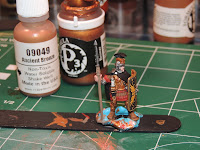
 I've begun my elite Praetorian Guards minis. This is my first one; trying out different colors for the armor and tunic, etc. Finally this pattern strikes me as a good balance of a Praetorian Guard soldier field uniform that maintains the allure of the palace Praetorian dress uniform. Used Ancient Bronze Masters Series Paint for the breastplate, leg greaves and helmet accent.
Still have some light paint touching up to do (e.g. the Pilum with P3's Beast Hide) and then I will gloss poly seal the mini for the follow-up Army Painter Dip "dipping" and then Litko basing (will probably base 2 minis each) then matte varnish to finish.
Of Note: The initial purpose of the Praetorian Guards differed greatly from the later Guards, which came to be a vital force in the landscape of Rome. While Emperor Augustus understood the need to have a protector force in the maelstrom of Rome, he was careful to uphold the Republican veneer of his regime. Thus he allowed only nine Guards Cohorts to be formed, originally of 500, then increased to 1,000 men each, and only three were kept on duty at any given time inside the capital. A small number of detached Praetorian cavalry units (called Turmae) of 30 men each were also organized. The 3 Cohorts patrolled in the palace and around major buildings, while the others were stationed in the towns surrounding Rome. This system was not radically changed with the appointment by Augustus in 2 BC of two Praetorian Prefects, Quintus Ostorius Scapula and Publius Salvius Aper, although the organization and command were vastly improved.
I've begun my elite Praetorian Guards minis. This is my first one; trying out different colors for the armor and tunic, etc. Finally this pattern strikes me as a good balance of a Praetorian Guard soldier field uniform that maintains the allure of the palace Praetorian dress uniform. Used Ancient Bronze Masters Series Paint for the breastplate, leg greaves and helmet accent.
Still have some light paint touching up to do (e.g. the Pilum with P3's Beast Hide) and then I will gloss poly seal the mini for the follow-up Army Painter Dip "dipping" and then Litko basing (will probably base 2 minis each) then matte varnish to finish.
Of Note: The initial purpose of the Praetorian Guards differed greatly from the later Guards, which came to be a vital force in the landscape of Rome. While Emperor Augustus understood the need to have a protector force in the maelstrom of Rome, he was careful to uphold the Republican veneer of his regime. Thus he allowed only nine Guards Cohorts to be formed, originally of 500, then increased to 1,000 men each, and only three were kept on duty at any given time inside the capital. A small number of detached Praetorian cavalry units (called Turmae) of 30 men each were also organized. The 3 Cohorts patrolled in the palace and around major buildings, while the others were stationed in the towns surrounding Rome. This system was not radically changed with the appointment by Augustus in 2 BC of two Praetorian Prefects, Quintus Ostorius Scapula and Publius Salvius Aper, although the organization and command were vastly improved.
Later, through the machinations of an ambitious Praetorian Prefect, Lucius Aelius Sejanus, the remaining outlying Cohorts were brought into barracks closer to Rome itself. In AD 23, Sejanus convinced Tiberius to have the Castra Praetoria (the fort of the Praetorians) built just outside of Rome. Henceforth the entire force was at the disposal of the Emperors, but the rulers were now equally at the mercy of the Praetorians. The reality of this was seen in AD 31 when Tiberius was forced to rely upon loyal Praetorian Cohorts against other Cohorts loyal to Perfect Sejanus. Although the Emperor's loyal Praetorian Guards eventually proved out to the aging Tiberius, their potential political power and danger had been established (something Emperor Caligula would later discover to his peril in AD 41 when he was assassinated by the Praetorians).
While campaigning, the Praetorian Guard Cohorts were the equal of any formation in the Roman Army. On the death of Emperor Augustus in AD 14, his successor Tiberius was faced with mutinies among both the Rhine and Pannonian Legions. According to Tacitus, the Pannonian forces were dealt with by Tiberius' son Drusus, accompanied by two Praetorian Cohorts, the Praetorian cavalry and some of the German bodyguard. The German mutiny was put down by Tiberius' stepson Germanicus, his intended heir, who then led the Legions and detachments of the Guards in an invasion of Germany over the next two years (and achieved revenge for the massacre of 3 Legions at the Battle of Teutoburg Forest). The Guard was quite active circa AD 69; they fought well at the first Battle of Bedriacum for Otho. Under Emperors Domitian and Trajan, the Praetorian Guard Cohorts took part in wars from Dacia to Mesopotamia, while with Emperor Marcus Aurelius, years were spent fighting on the Danubian frontier. Throughout the 3rd century, the Praetorian Cohorts assisted the Emperors in various campaigns.
I've started on my Batavian Infantry Auxilia Centuries (I plan on creating only 2 Centuries at the moment, a Batavian and a Tungrian... that may grow later). I'm using Aventine's EIR30, 31 and 32 (& UD47) packages of auxiliary soldiers in scale and mail armor with Robinson type "C" helmets to build out each Century. I plan on using two variations of LBMS oval shield transfers to differentiate between the 2 units. The minis come with a light spear and an oval auxiliary Scuta, called a Clipeus.
I've almost finished the painting here... I think I will bronze the helmets with P3's Brass Balls as that is more appropriate for Auxilia helmets. Next I will gloss varnish and then comes the "dipping" and finally basing and matte varnishing. I think these units do a great job of representing Roman Auxiliary units.
Of Note: Emperor Augustus re-organized Rome's Auxilia infantry units into Cohorts of roughly 500 men. These were under the overall command of a Tribune, and were divided into six Centuries, each commanded by a Centurion (like their Legion counterparts) and often operated independently in regions of lesser importance to the Empire.
The Roman Auxiliary came in many types. For example, the Balearic slingers, and the archers and spearmen of Numidia, Crete, and Syria are best known for the roles they played in Julius Caesar's Gallic conquest and the Pompey Civil War. However, the most common form of Auxilia infantry were the common "Bracati" soldiers; named for the bracae trousers they wore underneath their tunics. The average infantryman of an Auxilia Cohort was armed similarly, if not identically, to a Roman Legionary. Each carried a Clipeus - a flat oval shield (Scuta), which was indeed suited to quicker movement, but was nonetheless almost as heavy as a Legionary rectangle Scutum. He also learned to march and fight under the weight of a chain-mail or scale-mail tunic and a helmet. An auxiliary infantryman was armed with a Gladius thrusting sword and a Pugio dagger the same as a Legionary; and they variously carried one of several Hastae (thrusting spears), Pila (heavy javelins), or Lancae (light javelins) for primary weapons.
There is much evidence starting in the 1st Century AD, that the Batavian Auxiliary Cohorts were every bit as effective as soldiers as their higher-ranking and supposedly better-trained rivals in the Legions. Auxiliaries, both cavalry and infantry, saw hard fighting during the British wars that were waged on and off between the 40's and the 80's AD, as well as during the Year of Four Emperors, 69-70.
Roman Historian Tacitus, tells us of several Auxiliary Cohorts that became among the most elite and decorated units in the entire Roman Army. These included the Batavian Cohorts, recruited from amongst the Germanic Batavi, and the Tungrians, who were part of the Gaulish Celts. The Batavian people (one of Rome's earliest allies... in the area of what today is the Netherlands) were entirely exempt from paying Roman taxes, but they were expected to send all of their able-bodied young men off to serve in the Roman Auxilia.
A Batavian Revolt occurred in 69-70 AD, and it was put down only after hard fighting. The Batavians proved their combat powers by managing to defeat veteran Legionaries in battle; in fact they destroyed two Roman Legions completely before a massive Roman field army under General Quintus Petillius Cerialis crushed them. Like the Legionaries, they marched forward in-line, throwing one or more volleys of javelins and then letting out a ferocious war-cry before charging at very close range into their enemy, knocking them backwards with their shields and thrusting swords into their mouths, throats, hearts, bellies, and groins.
The Batavians combined the fierce spirit of the barbarian warrior with the superior training and equipment of a skilled Roman Legionary. Tacitus records that both the Batavi and Tungri fought with amazing courage and skill at the Battle of Mons Graupius in 83 AD and defeated a much larger Caledonian force. They used proper Roman Legion technique with their swords and shields, revealing that they had been trained as thoroughly as their Legionary comrades.
Not only were the Auxiliaries capable of fighting like Legionaries; sometimes they were even given the place of honor in the battle-line in place of the Legionaries. At Idistaviso (16 AD), Vetera (70 AD), and Mons Graupius (83 AD) the Auxiliary Cohorts formed the vanguard of the Roman field army. Undoubtedly this was, at least to a point, due to the fact that as non-citizens and often as "barbarians", the Auxilia Cohorts were of less value to Roman generals than the Legions. But more importantly it attests to the fact that Roman Auxilia were well-trained, well-armed, and expected to have the guts to stand up to the front rank of an enemy force--not just fill the secondary roles that some authors have confined them to.

 I've begun my elite Praetorian Guards minis. This is my first one; trying out different colors for the armor and tunic, etc. Finally this pattern strikes me as a good balance of a Praetorian Guard soldier field uniform that maintains the allure of the palace Praetorian dress uniform. Used Ancient Bronze Masters Series Paint for the breastplate, leg greaves and helmet accent.


